In accordance with ancient decree, the Temple Indivisible has wisely forbade that any bodies be buried within the walls of the City of Shuttered Windows. Instead, the White Road that worms northwards from the North Gate of the city through mire that quickly gives way to farmland is lined with thousands of tombs. They cluster close to the road, each one covered in carvings that beg travelers to stay a while and read about the citizen entombed there so that they might not be forgotten. As all of the more visible plots were built on centuries ago, newer tombs go to greater and greater lengths to attract attention, some rising high among their fellows, some marked with a riot of color and some imbued with strange glamours.
For those too poor to afford a tomb along the White Road, the Temple Indivisible has thoughtfully provided a place for them as well. Their bones are ground down and used to pave the road itself and layer upon layer of bone grit keeps the White Road remarkably mud-free.
Features:
- The Restless Dead: the commoners whose bones were ground up to pave the White Road do not rest easy.
- The White Road is a vast undead being that is kept chained by the Necromantic Office.
Connections:
- Anastasia, the self-styled Princess of Seers plans to wake the undead of the White Road (23.11.01). This location is mentioned in a strange journal which discusses why it rains but once a year.
- One of the most famous tombs that line the road here is that of Doge Simone the Fowl.
Hooks:
- Why is it “wise” to not bury bodies within the City?
- Why do the citizens of Shuttered care about having people stop at and read the carvings on their tombs?
- Any interesting undead about?
- Boys from the village of Hostwick (39.14) who develop the proper signs after eating strange catterpillars are castrated and sold to the Necromantic Office. Why?
The Restless Dead
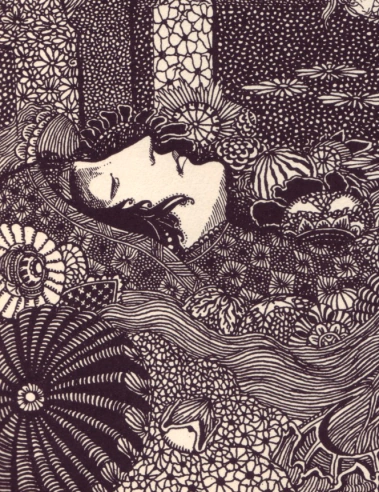 Connects to: 16.16.04, 26.13 and the City of Shuttered Windows
Court necromancers and hedge mediums have long speculated on what causes the dead to return to life. Surely the process that conjures back a warhorse from a skin bag is different from the bindings that draw bone golems together.
But what is broadly agreed is that—at least for humans and talking animals—undeath requires anonymity. Skeletons—about whose past little can be discerned—are more powerful than zombies, and jumbles of many bones are some of the most persistent of the dead.
Of course, no one is more anonymous than yet another corpse in the big city, and for this reason people are buried along the White Road. Their tombs include careful (and embarrassingly honest) accounts of their lives so that should you come back as a ghoul or spectre, anyone who happens to have read the story of your life can talk you back into your grave.
Shuttered City funerals are festive, but not celebrations of the person’s life: celebrations encourage rose-coloured glasses, exaggerations and white lies. In fact, no one receives louder applause at a funeral than a person’s worst enemy who, it is believed, will describe one’s faults best and most memorably of all.
Connection:
- This theorizing appears to be suppored by the power of the White Road itself.
Hooks:
- What happens if you mix the bones of humans/talking animals and other animals?
- The opposite effect seems to function for non-talking animals—the warhorses are all storied and famed. Or is there something else going on here?
- Whose history has been lied about the most?
- This would explain why all ghosts have mysteries associated with them. But why do most people who are not well known not come back as undead?
White Road, Wailing Road
Connects to: 23.11, 24.18, 29.13, 29.13.02 and 29.14.35.
The Sages say that the more anonymous a corpse the more likely it is to be restless in its death. This explains many funeral ceremonies that take place across the lands. But what then of of the poor of the City of Shuttered Windows, whose bones are ground up to make the White Road? Isn’t that the most anonymous fate of all? Indeed it is; which is why one of the greatest works of the servants of the Necromantic Office is to keep the road quiet.
However, as one nears the end of the White Road, before the paving of bone dust peters out as the trade road approaches Winds (23.11), the necromantic bindings begin to weaken and the road grows restless.
On certain dark nights the road has been known to rise up and consume whole caravans and even change its course, the voices of ten thousand angry dead gibbering in a cacophonous chorus. However, when the morning dawns the road always quiets and is forced back into its proper course.
However, even on those nights when this far stretch of the White Road seems quiet it not so. It is only that the upmost layer of the road has been bound in place while the lower strata of bone dust wails and moans and woe to him who digs down into the dust of the White Road at night for he is surely lost.
This is the source of the winds that blow through the caves below the aptly-named town of Winds. They are the screams of the unquiet dead of the White Road that filter through the dark caverns that lead down into the Sunless Sea before reaching Winds.
The fames windseers of Winds are those who are able to recognize the winds for what they are and listen to the voices of the dead and glean wisdom from it, hopefully without going completely insane.
Connection:
Hooks:
- Have the spells binding the White Road ever been lifted to, for example, eat an invading army marching down the road?