 Connects to hexes: 13.02, 13.12, 17.05, 17.06, 18.07, 20.10, 25.04, 25.04.01, 29.07.01, 48.18.02 and the City of Shuttered Windows.
Newhill is so named because at the time of settlement it was, indeed, a new hill – kicked up out of the earth from the attack that razed the Citadel of the Verlimes (18.07). Newhill overlooks that damned place and its surroundings. Residents of the freehold claim the air atop their hill is a bit sweeter, the spring waters clearer. Sadly, visitors are probably too creeped out by the scenic view of elementals marching about the old Citadel ruins to notice.
It takes a special brand of crazy or desperate to live within spitting distance of a haunted ruin. The forefathers of Newhill’s current residents were indeed mostly bandits and refugees with no place else they would be welcome. Over the centuries, the peoples of Newhill have become more or less domesticated, but the freehold still has a reputation for being a haven for the rough, the tough, and the mildly insane.
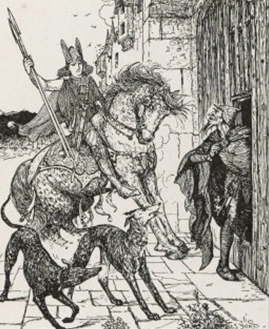
The freehold itself is surrounded by a wooden palisade, and contains ought much but the family homes of three merchant families that share dominion over the place. “Maud” Verlime is a bent over crone, who will talk the ear off of anyone willing to listen. She is the overly proud matriarch of the Verlime Who Remained. She is mother to Regulus Verlime of the Sundial Inn (25.04), her least favorite son. She is mother to six others, grandmother to thrice as many, and lives with a pair of sisters who never married or had children. Etched into a stone laying at the center of their impressive sized home are the names of all the firstborn given up to the elves (18.07).
One of Maud’s favorite stories, one that she tells over and over to anyone whose ear she can corner, is personally chasing the famed, masked raider Huu Vo Malkus (29.07.01) off of her grazing lands some thirty odd years ago. Of course, the detail she often fails to mention is Malkus absconding with the family’s herd of ostriches. In the decades since, the Verlime herd has been replenished, and currently grazes in the fields surrounding Newhill. While the name Verlime is practically a curse word throughout most of the freeholds, in Newhill they retain some of their old role as protectors of the region.
The second powerful family is the Pignoses, who claim some orcish blood– proudly in fact. They are a physically brutish collection of men and women, but in heart usually fairly gentle folk. Big Sal Pignose is the most accomplished of the lot. She’s a successful trader, enough so that she purchased a citizen’s charter from the City of Shuttered Windows. Her kids are spoiled brats and often get into brawls with the younger of the Verlimes.
The third family within the palisades is the Stannev, a family of orchid-tenders and honey-harvesters who share a generational devotion to The King in Splendor, Sword that Slays the Night (25.04.01). Their lighthouse-temple, The Everwatching Eye, is the only stone structure in Newhill. Currently Loris Stannev serves as the high priest tending to this shrine, but as she ages (nearly 70 now), three of her nephews currently vie to become the new shrine-tender. The competition between the three isn’t entirely friendly, as the faith of the King in Splendor values open displays of strength.
The Stannev hold a long tradition of alliance with both the Verlime and Pignoses, often being the family that stands in the middle and mediates any conflict between the two clans.
Subhexes:
- 17.07.01 (The Lion’s Day): the midsummer holiday of the sun god.
- 17.07.02 (The Testament of Weneslas Stannev): a religious text about the sun god.
- 17.07.03 (The Chant of Morning): a hymn to the sun god.
- 17.07.04 (The Fat Friar Inn): a local inn famous for its comfy cat-feather pillows.
- 17.07.05 (The Beauty of Olga Pignose): the young daughter of a half-orc and a half-elf is the most beautiful child in these lands.
- Droesh the duelist has just arrived in town.
Connections:
- The Stannevs are responsible for the ruin of the Tellevs (13.12).
- A well lit road (17.06) connects this freehold with that of the Furfeet (17.05) with whom the Furfeet once had a feud (17.06).
- Flea, a local bandit leader, has an agent working for him here to tip him off about caravans and vigilantes (20.10).
- Horvarth Pignose is one of the cattle barons of Sosaria (48.18.02).
- Some locals have been kidnapped by the elf Cerelaine for use in his experiments (13.02).
- The library at Newhill is one of only three places that has a copy of the Testament of Weneslas Stannev
The Fat Friar Inn
 Connects to: 34.05.
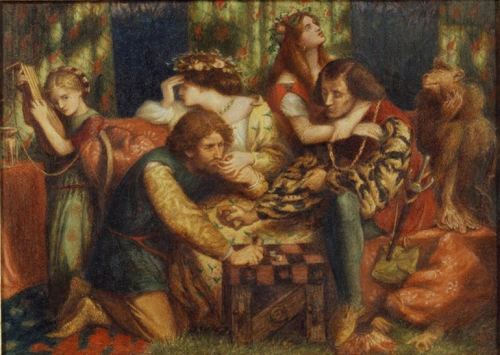
The Fat Friar’s cozy, quiet atmosphere is almost unnerving to travelers ducking in from Newhill’s rough-and-tumble lanes. The common room is a stone cellar warmed by a great hearth and crowded with small tables and cushioned stools. Rodolf, an immense, gregarious fellow, runs the place. He leads songs and strums his mandolin with revelers late into the night.
The Fat Friar is most famous for its beds. Even the most tormented, addled heads can find peaceful slumber when they rest on the inn’s pillows. Rodolf’s secret is the three feathered cats (34.05) he keeps in cages. He meticulously gathers their down and feathers to fill his pillows.
Last month, three of Rodolf’s cat-feather pillows disappeared. Shortly afterward, mystified and embarrassed travelers began admitting to being ambushed by a masked figure near the palisade gates. Their accounts are similar: A pillow to the face, and waking up hours later stripped of everything valuable. Rodolf quietly offers gold for returned pillows to adventurers he deems trustworthy.
Hooks:
- How did Rodolf get three feathered cats?
- What troubled minds lay their heads to rest at the Fat Friar?
- The pillow bandit clearly has one of his missing pillows. What has happened to the other two?
- Who is the pillow bandit? Where is his/her lair?
The Beauty of Olga Pignose
 Connects to: 02.03, 29.14.26 and 29.14.50.
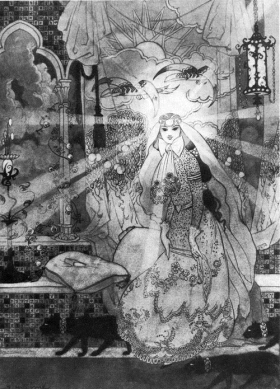
The child of the local half-orc Hilda Pignose and a travelling half-elven bard, Olga Pignose is the most beautiful child in all of these Shrouded Lands. Her eyes can melt even the heart of a Hoard dwarf (33.00) and her hair is flowing midnight with such a sheen as to make even the elves of the Kingswood gasp with envy. She is already taller than her mother, but still more graceful than many of the finest Shadowed Ballet dancers (briefly mentioned in 50.11 and 40.20.01) of Shuttered. Unbeknownst to Olga’s proud mother, an ancient scroll (of which every copy was burned long ago) entitled the Breath of Alberon seems to speak of the girl. The only known information about this work is a summary in the Record of Past Heresies (which can be found in the Sealed Library) which talks of claims that Alberon will one day be born of elf and orc, and not of man, and that after he is born he will slip between the streams of time to rule the City in its gloried past (29.14.26). Few people take this seriously as everyone knows that elves and orcs cannot have children. There are also references to theories that there was once an ancient race of god-men that was sundered into the elven and orcish races, each of which contain only fragments of their ancestors’ glory.
But whatever else she is, Olga isn’t Alberon or a god-man. She’s a she who is still half-human. But the child isn’t too concerned with that. She’s busy exercising her wings and hopes that she’ll be able to fly soon.
Connection:
- Olga dreams of Mt. Scorshia (02.03).
Hooks:
- Who’s Olga’s father?
- Why does Olga have wings? How tall is she going to get?
- Is what is written in the Breath of Alberon actually true? Who were the ancient god-men? How did they become elves and orcs? Is Alberon going to be Olga’s son or what?
- The Record of Past Heresies has just a brief summary of the Breath of Alberon. Is there any way to get to the original? Maybe from a kobold (45.09)? A snake (41.24)? Did the Weeper read it (43.08)?
- Are there any other children of half-elves and half-orcs around? Both of those half-breeds are rare so their children must be even rarer, perhaps Olga is the first one.


